<?xml version="1.0" encoding="utf-8"?><feed xmlns="http://www.w3.org/2005/Atom" ><generator uri="https://jekyllrb.com/" version="3.10.0">Jekyll</generator><link href="https://www.dannyquah.com/feed.xml" rel="self" type="application/atom+xml" /><link href="https://www.dannyquah.com/" rel="alternate" type="text/html" /><updated>2026-05-12T08:51:01+00:00</updated><id>https://www.dannyquah.com/feed.xml</id><title type="html">Danny Quah / Worksite</title><subtitle>personal description</subtitle><author><name>Danny Quah</name><email>D.Quah@nus.edu.sg</email></author><entry><title type="html">Third Nations Can Piece Together a Ruptured World Order</title><link href="https://www.dannyquah.com/2026/03/13/Third-Nations-Repair-Ruptured-World-Order/" rel="alternate" type="text/html" title="Third Nations Can Piece Together a Ruptured World Order" /><published>2026-03-13T00:00:00+00:00</published><updated>2026-03-13T00:00:00+00:00</updated><id>https://www.dannyquah.com/2026/03/13/Third-Nations-Repair-Ruptured-World-Order</id><content type="html" xml:base="https://www.dannyquah.com/2026/03/13/Third-Nations-Repair-Ruptured-World-Order/"><![CDATA[<h3 id="third-nations-can-piece-together-a-ruptured-world-order">“Third Nations Can Piece Together a Ruptured World Order”</h3>

<p>by<br />
<a href="https://lkyspp.nus.edu.sg/our-people/faculty/danny-quah">Danny Quah</a><br />
Mar 2026</p>

<p><em>Synopsis: Third nations have long been expected to endure the consequences of major-power actions. But instead of treating such whims as inevitable, third nations can actively mitigate external shocks by forging coalitions with states that share common interests and are willing to commit to collective rules. Such pathfinder multilateralism, exemplified by coalitions like ASEAN and the CPTPP, may provide a roadmap for stability and growth in a G-minus world.</em></p>

<p><a href="https://eastasiaforum.org/2026/03/13/third-nations-can-piece-together-a-ruptured-world-order/"><img align="right" width="100%" src="https://DannyQuah.github.io/Storage/2026.03.13.Fri-Danny.Quah-Third-Nations-Ruptured-World-Order-EAF-cover.png" alt="Quah 2026 EAF - Third nations can piece together a ruptured world order" /></a></p>

<p>With escalating great power disruption and rising geopolitical rivalry, third nations now feel the pressure to navigate a new world order. These states are neither on the frontline of geopolitical conflict nor do they want a ruptured international system. They did not shape the current world order, yet they are watching it grow increasingly unsettled.</p>

<p>There is <a href="https://eastasiaforum.org/2025/08/24/asias-response-to-a-leaderless-trading-system/">fracture in the system</a> of global norms built over the past eight decades. Washington, once architect of the rules-based order, now seeks to rewrite the world order to its own advantage. It has delivered a <a href="https://dannyquah.substack.com/p/a-two-shock-model-for-indo-pacific">US shock</a> to the global economy as disruptive as the China shock. As globalisation and multilateralism unravel, third nations must move beyond behaving as price takers to exercising proactive economic diplomacy.</p>

<p>One way to advance foreign policy objectives is through economic instruments — the practice of economic statecraft. In Washington, this is traditionally viewed as a means of working US geopolitical will in the world. For smaller nations, the goal is more modest — to avoid becoming collateral damage in major power competition.</p>

<p>To achieve this goal smaller nations will need to pursue three strategic pathways — alignment, acquiescence or mitigation.</p>

<p>Alignment means taking a side in a binary geopolitical decision. If two major powers are imagined as points connected by a straight line, placing a third nation at either endpoint represents perfect alignment with that power. Other locations along that line represent generalised alignment through strategies like balancing, hedging and bandwagoning. But specific instances of generalised alignment will only be optimal when the geopolitical environment is zero sum, so that gains for one side imply losses for the other.</p>

<p>Generalised alignment bundles together choices on trade, technology and security into a single setting across what would otherwise be multiple degrees of freedom. An alignment setting should be relatively long-lived. Extreme short-term alignments with constant shifts are meaningless.</p>

<p>Unlike alignment, acquiescence can be understood as a specific form of appeasement. Acquiescence surfaces when a third nation must deal with a major power whose broader national objectives are unclear or whose leadership is unpredictable.</p>

<p>In these cases, third nations can use cheap-talk signalling or high-visibility but low-substance actions. These might include symbolic awards or projects named in honour of a foreign leader. The purpose is to draw a positive response from the major power and stabilise the third nation’s foreign policy environment without making enduring strategic commitments. While alignment is long lived, acquiescence is immediate and short-term.</p>

<p>Mitigation represents the most novel and proactive approach for third nations. If alignment places a state somewhere along a straight line between major powers, mitigation involves stepping off that line altogether so that the third nation seeks to reshape the causes of external shocks rather than simply reacting to them.</p>

<p>As in the case of climate policy, mitigation sits alongside adaptation. Adaptation minimises the impact of shocks by, for example, developing a more resilient workforce or building more robust production infrastructure. Mitigation targets the root causes of these shocks, reshaping the system to prevent disturbances from emerging in the first place — by forging new multilateral frameworks for instance.</p>

<p>Mitigation shifts the focus from power hierarchy to incentive compatibility. Rules-based trade does not logically require a benevolent hegemon, only coalitions of the willing where no member has a unilateral incentive to deviate from the agreed rules. Recourse to leadership by major or middle powers is not a logical necessity but instead indicates weaknesses in institutional design.</p>

<p>Two examples of mitigation already in operation are ASEAN and the Comprehensive and Progressive Agreement for Trans-Pacific Partnership (CPTPP). ASEAN is a coalition of 11 nations that emphasises ‘<a href="https://eastasiaforum.org/2024/08/12/asean-centrality-use-it-or-lose-it/">ASEAN centrality</a>’ — the idea that the region itself determines its own outcomes rather than succumbing to external hegemonic power. Since 1967, ASEAN has served as a platform for pathfinder groupings committed to rules-based trade.</p>

<p>CPTPP was reconstructed from the original Trans-Pacific Partnership after US withdrawal in 2017. This grouping proves that high-standard trade agreements can exist and grow even absent US leadership.</p>

<p>The Regional Comprehensive Economic Partnership (RCEP) provides a different example of flexible topology in coalition building. While RCEP is the world’s largest free trade agreement — comprising ASEAN, China, Japan, South Korea, Australia and New Zealand — observers have remarked that RCEP standards have not been as ambitious as those of newer-generation trade deals. Nonetheless, ASEAN’s leadership and China’s economic heft have combined to make RCEP an economically pragmatic and attractive trading bloc.</p>

<p>ASEAN, CPTPP and RCEP represent pathfinder multilateralism, drawing on coalitions of the willing who seek to practice the rules of <a href="https://eastasiaforum.org/2025/11/07/free-trade-mega-bloc-key-to-success-in-post-us-economic-order/">globalisation and multilateralism</a> — cooperation, a level playing field and peaceful dispute resolution. These groupings are open to expansion, provided that new entrants follow the same agreed-upon rules.</p>

<p>The reality of today’s world order, where major powers are less constrained by international law and national sovereignty, points to the emergence of a G-minus world — an international system without the participation of an uncooperative major power. While the United States remains a significant market, the world already trades far more within itself than it does with the United States. A global economy without the United States would be poorer in general. But with incentive-compatible trade and security groupings that are prepared to expand under the rules of pathfinder multilateralism, a G-minus world can continue to grow.</p>

<p>Third nations are no longer restricted to passive roles assigned by traditional theories of realism, where smaller nations suffer what they must. Through mitigation — drawing on agile and networked coalitions — nations can build resilient and robust regional or interest-focused groupings decoupled from the whims of major powers. By prioritising incentive compatibility and decentralised governance over size and power, third nations can successfully navigate and <a href="https://www.imf.org/en/Publications/fandd/issues/2025/09/point-of-view-multilateralism-can-survive-the-loss-of-consensus-danny-quah">productively reshape</a> a disrupted world order.</p>

<p><em>Danny Ǫuah is Li Ka Shing Professor in Economics at the Lee Kuan Yew School of Public Policy, National University of Singapore.</em></p>

<p><em>This article is part of an</em> EAF special series <em>featuring papers from the 2026 Asian Voices and Visions Conference, co-organised by the Taipei School of Economics, the Taipei School of Economics and Political Science Foundation and the Harvard Kennedy School.</em></p>

<p><a href="https://doi.org/10.59425/eabc.1773396000">https://doi.org/10.59425/eabc.1773396000</a></p>

<p><a href="https://eastasiaforum.org/">EAF</a> | <a href="https://eastasiaforum.org/category/asian-voices-and-visions/">Asian Voices and Visions</a> | Third nations can piece together a ruptured world order</p>

<p>(This article is reproduced from the <a href="https://eastasiaforum.org">East Asia Forum</a> for readers’ convenience under a Creative Commons licence.)</p>

<!---
   Invisible section // 2026-03-13-Third-Nations-Repair-Ruptured-World-Order.md
-->]]></content><author><name>Danny Quah</name><email>D.Quah@nus.edu.sg</email></author><summary type="html"><![CDATA[“Third Nations Can Piece Together a Ruptured World Order”]]></summary></entry><entry><title type="html">AI inversion. I asked my local LLM to introspect and join up what I’d been thinking the last four years</title><link href="https://www.dannyquah.com/2026/02/27/AI-inversion-LLM-introspect/" rel="alternate" type="text/html" title="AI inversion. I asked my local LLM to introspect and join up what I’d been thinking the last four years" /><published>2026-02-27T00:00:00+00:00</published><updated>2026-02-27T00:00:00+00:00</updated><id>https://www.dannyquah.com/2026/02/27/AI-inversion-LLM-introspect</id><content type="html" xml:base="https://www.dannyquah.com/2026/02/27/AI-inversion-LLM-introspect/"><![CDATA[<h3 id="ai-inversion--i-asked-my-local-llm-to-introspect-and-join-up-what-id-been-thinking-the-last-four-years">“AI inversion.  I asked my local LLM to introspect and join up what I’d been thinking the last four years”</h3>

<p>by<br />
<a href="https://lkyspp.nus.edu.sg/our-people/faculty/danny-quah">Danny Quah</a><br />
Feb 2026</p>

<p>This past weekend I looked at my LLMs and decided that for a while I wasn’t going to be asking what the world says or knows.  Instead, I wanted to see the connections in and clusters of ideas, common turns of phrase, and formal parallels in statistical models and mathematical structures in and across the models of social mobility and of world order that I have been developing.  The source material had to be clearly circumscribed and controlled:  notes I keep of half-finished conjectures and ideas from what I’ve read; YouTube and podcast recordings of panels, roundtables, and fireside chats I’ve done; markdown and latex source of papers, blogs, and commentaries I’ve written.</p>

<video width="480" controls="">
  <source src="https://DannyQuah.github.io/Storage/2026.02.26.1120.Thu-original-DQ-second-brain-compressed.mp4" type="video/mp4" />
  Your browser does not support the video tag.
</video>

<p>I wanted the ideational connections across these mathematical and conceptual models updated in real time, and I didn’t want this source material uploaded to the cloud.  I wanted to query locally and dynamically my second brain, not just look at its connections graphically, which Obsidian had already long allowed me to do.</p>

<p>So I rigged up on my MacBook Air an ollama runner, and downloaded onto it a Chat Model and a RAG Embedding Model, compact enough to run in 16Gb RAM. Then, because everything happens locally, there are no API or subscription charges, and I know any conclusion I draw comes only from thoughts I had myself.</p>

<p>It works.  I got connections, gaps, blindspots, suggestions.</p>

<p>In the 1m02s animation, each of the nearly 6,000 nodes is a document, URL, or other link; and the size and links represent ideational footprint and connection strength.</p>

<p>(If I’d known ahead of time the below was all I had to do, it would have taken only 5mins to get up and running:</p>

<div class="language-plaintext highlighter-rouge"><div class="highlight"><pre class="highlight"><code>curl -fsSL https://ollama.com/install.sh | sh  
ollama pull llama3:8b-insgtruct-q4_K_M  
ollama pull nomic-embed-text  
</code></pre></div></div>
<p>Obsidian Copilot plugin:</p>
<ul>
  <li>Self-hosted ollama API <code class="language-plaintext highlighter-rouge">http://localhost:11434</code>; ignore all other API key requests</li>
  <li>Chat model <code class="language-plaintext highlighter-rouge">llama3:8b-insgtruct-q4_K_M</code>; embedding model <code class="language-plaintext highlighter-rouge">nomic-embed-text</code></li>
  <li>For API key of both chat and embedding models, don’t leave blank but put in any string  (like <code class="language-plaintext highlighter-rouge">x</code> or <code class="language-plaintext highlighter-rouge">ollama</code>).</li>
  <li>In tab QA, set embedding model to <code class="language-plaintext highlighter-rouge">nomic-embed-text (Ollama)</code></li>
  <li>Use <code class="language-plaintext highlighter-rouge">vault QA (free)</code></li>
</ul>

<!---
   Invisible section // 2026-02-27-AI-inversion-LLM-introspect.md
-->]]></content><author><name>Danny Quah</name><email>D.Quah@nus.edu.sg</email></author><summary type="html"><![CDATA[“AI inversion. I asked my local LLM to introspect and join up what I’d been thinking the last four years”]]></summary></entry><entry><title type="html">Negotiating an Inelastic US: Why G-minus is the Realist Outcome</title><link href="https://www.dannyquah.com/2025/10/19/Negotiating-Inelastic-US-G-minus/" rel="alternate" type="text/html" title="Negotiating an Inelastic US: Why G-minus is the Realist Outcome" /><published>2025-10-19T00:00:00+00:00</published><updated>2025-10-19T00:00:00+00:00</updated><id>https://www.dannyquah.com/2025/10/19/Negotiating-Inelastic-US-G-minus</id><content type="html" xml:base="https://www.dannyquah.com/2025/10/19/Negotiating-Inelastic-US-G-minus/"><![CDATA[<h3 id="negotiating-an-inelastic-us-why-g-minus-is-the-realist-outcome">Negotiating an Inelastic US: Why G-minus is the Realist Outcome</h3>

<p>by<br />
<a href="https://lkyspp.nus.edu.sg/our-people/faculty/danny-quah">Danny Quah</a><br />
Oct 2025</p>

<p><em>Synopsis: If the US only ever responds inelastically, its diminished international relevance is the expected Realist outcome.  If US trade policy continues to make it costlier for countries to export to the US, then those countries will eventually stop exporting to the US.  This is the natural progression from G7 to G2 to G-zero … to G-minus.</em></p>

<figure>
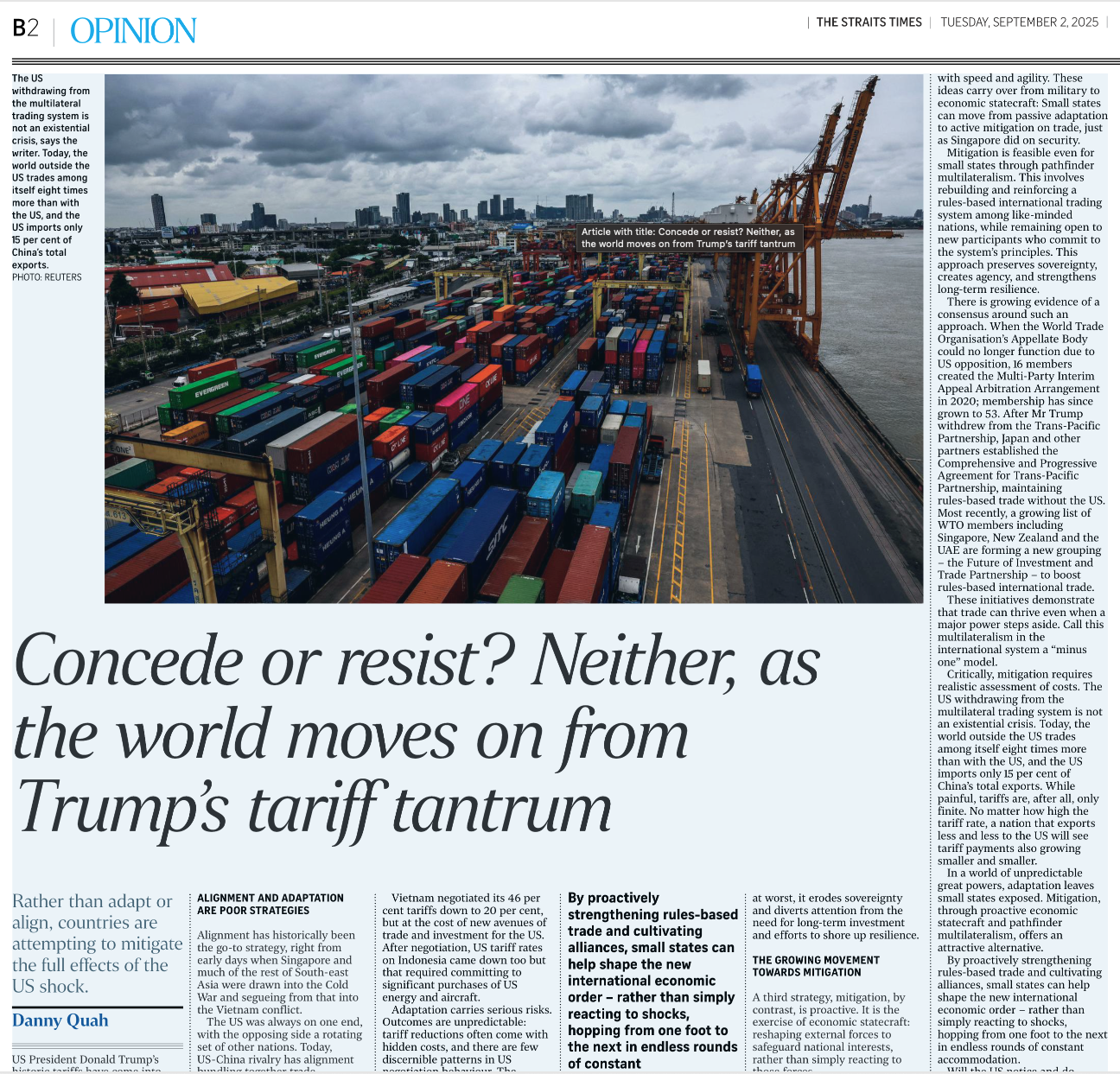
<img align="right" width="100%" src="https://DannyQuah.github.io/Storage/2025.09.02.Tue-Danny.Quah-Concede-or-resist-ST-epaper-p22.png" alt="Quah 2025 - Mitigation, not acquiescence or alignment" />
<figcaption>Danny Quah. 2025. Mitigation, not acquiescence or alignment.  Straits Times (Sep)</figcaption>
</figure>

<hr />

<p>Whatever concessions different nations offered in response to Trump’s Liberation Day Tariffs (LDT), they must have expected sacrifice would earn returns.  In geoeconomics and international politics, making concessions, acquiescing, and aligning attract reward.</p>

<p>The assumption is that when you give up something so that others gain, in exchange they offer you something valuable in return.  In labour market economics, if you employ workers and you offer higher wages, you expect a higher labour supply.  When you are buying a car and are willing to pay a higher price, you expect the car dealer to provide you a more valuable vehicle.  So, too in Great Power geopolitics: if you make concessions, are acquiescent, and align with a Great Power, you ought to receive more of whatever you find valuable in what that Great Power provides.</p>

<p>Economists describe this as elasticity, and the concept can be expressed numerically: for instance, labour supply elasticity is the ratio of the percentage increase in labour supply to the percentage increase in wage offer.</p>

<p>What did nations encounter in their making concessions to the Trump administration on LDTs?  They learnt that US elasticity towards them is either zero or negative.  Nations that worked hard and made sacrificial concession not only got nothing substantive in return but in several high-profile cases, their circumstances actually worsened.</p>

<p>Vietnam was first to negotiate with the Trump administration.  Faced with a LDT rate of 46%, Vietnam managed to negotiate rates down to 10-15%, only to have Trump unexpectedly announce a rate of 20% in general and of 40% on those goods the US identified as trans-shipments. In addition, Vietnam appears to have ignored its own domestic laws in fast-tracking a USD1.5bn Trump family golf complex in Hung Yen Province.</p>

<p>Indonesia began with an LDT of 32% that got lowered to 19% in mid-July. In return, however, Indonesia has committed to USD34bn purchases of US energy, US agricultural products, and US aircraft, and to invest in Louisiana blue ammonia industry.  India’s LDT started at 26%, was lowered to 25% in mid-August, but then doubled to 50% (because of its continuing purchases of Russian crude oil), with India’s jewelry, gems, and textiles industries coming under immediate and extreme risk.  South Korea’s LDT of 25% was negotiated down to 15% by early August but then had to commit to invest USD350bn in US “strategic projects” and USD100bn in US energy products.  (We can also note in passing that South Korea had a Free Trade Agreement with the US.)  Similarly, Japan’s LDT of 24% came down, with negotiations, to 15%, but Japan had to commit to invest USD550bn in US projects in EV supply chains, shipbuilding, and semiconductors.  Malaysia obtained an early-August tariff rate of 19%, down from LDT 24%, but then had to commit to a USD240bn package of spending and investment on US energy, aircraft, and semiconductor and data equipment.</p>

<table>
  <thead>
    <tr>
      <th style="text-align: left">Economy</th>
      <th style="text-align: left">LDT%</th>
      <th style="text-align: left">Effort</th>
      <th style="text-align: left">Current tariff%</th>
      <th style="text-align: left">Purchase and Investment commitments in US</th>
    </tr>
  </thead>
  <tbody>
    <tr>
      <td style="text-align: left">VN</td>
      <td style="text-align: left">46</td>
      <td style="text-align: left">VN General-Secretary To Lam first to call Trump; DC negotiations involving Bessent, Lutnick, and Greer, through July</td>
      <td style="text-align: left">20-40</td>
      <td style="text-align: left">Preferential access in VN for US large-engine automobiles.  Initially negotiated rates of 10-15% unexpectedly raised by Trump, in 02 July discussion, to 20% generally, and 40% for those goods the US identified to be trans-shipments. USD1.5bn Trump family golf complex in VN.</td>
    </tr>
    <tr>
      <td style="text-align: left">ID</td>
      <td style="text-align: left">32</td>
      <td style="text-align: left">DC negotiations, through mid-July, with Prabowo speaking directly to Trump. Exempted US companies from local content requirements.</td>
      <td style="text-align: left">19</td>
      <td style="text-align: left">USD34bn commitment to buy US energy, agricultural products, aircraft. Accepted US standards on vehicles, pharmaceuticals, and medical devices.</td>
    </tr>
    <tr>
      <td style="text-align: left">IN</td>
      <td style="text-align: left">26</td>
      <td style="text-align: left">Delhi, DC, and New York negotiations, initially focused on India’s opening market access and committing to purchases of aircraft and energy, before attention shifted to India’s purchases of Russian crude oil</td>
      <td style="text-align: left">50</td>
      <td style="text-align: left">After a post-LDT reduction to 25%, tariff rates were hiked in late Aug to double that level because of India’s continuing imports of Russian crude oil.  India’s politically important constituencies of jewelry, gems, and textile industries at immediate risk.</td>
    </tr>
    <tr>
      <td style="text-align: left">KR</td>
      <td style="text-align: left">25</td>
      <td style="text-align: left">DC negotiations, said to be grueling, from broad frameworks to technical discussions. No additional testing in Japan of US-made cars.</td>
      <td style="text-align: left">15</td>
      <td style="text-align: left">KR already had a Free Trade Agreement with the US, that these arrangements now abrogate.  KR commitment of USD350bn to US “strategic projects” investment, plus USD100bn spending on US energy over the next 4 years. Committed to hike defense spending to over 8% GDP, with concerns the US might make further security demands.</td>
    </tr>
    <tr>
      <td style="text-align: left">JP</td>
      <td style="text-align: left">24</td>
      <td style="text-align: left">Eight rounds of negotiations in DC, with breakthrough after meeting between Treasure Secretary Bessent and Prime Minister Ishiba</td>
      <td style="text-align: left">15</td>
      <td style="text-align: left">JP commitment of USD550bn to sectors to be directed by the US government, including critical minerals, shipbuilding, and semiconductors. Moreover, the US administration will retain 90% of the profits from these investments.</td>
    </tr>
    <tr>
      <td style="text-align: left">MY</td>
      <td style="text-align: left">24</td>
      <td style="text-align: left">DC negotiations, through early Aug</td>
      <td style="text-align: left">19</td>
      <td style="text-align: left">USD240bn to US energy, aircraft, and semiconductor and data equipment</td>
    </tr>
  </tbody>
</table>

<p>To get a sense of proportion, Japan’s annual GDP is USD4.03tn, so its investment and spending commitment to the US is 14 percent.  For South Korea, it is 26 percent; for Malaysia, 57 percent!  These investment and spending packages are so significant that South Korea has requested currency swap lines to help manage the foreign exchange impact.  Japan is expected to draw on an existing one already in place with the US since 2013.  (Malaysia has not yet requested a currency swap line.)</p>

<p>In economic terms, US elasticity is either zero or negative in response to concessions (and acquiescence and alignment).  The right response is to stop making concessions and to stop acquiescing and aligning with the US.  Some observers might say, yes, but even if acquiescence and alignment get us little in trade terms, it gets us political and security benefits from the US.  The question then is, if the elasticity between trade terms and acquiescence is so unfavorable, why does anyone think the cross elasticities will be any better?  Put another way, if you can’t trust the US to respond positively to your ventures on trade, why do you think it would do so in a situation of national security?</p>

<p>Regardless of one’s views on this, however, the elasticity of other nations’ is likely more reasonable.  As long as those elasticities are the right sign, then the more expensive it becomes to engage with the US, the less engagement there will be.  In economics, this is called a downward-sloping demand curve.  Extrapolating a trend from G20 to G7 to G2 to G-zero, we might therefore need to prepare for a G-minus world, where global engagement will no longer have the US in it.  No hard feelings, this is just Realism and economics.  Obviously, the world is better with America in it than not, but none of the rest of us can make that happen simply by wishing it.</p>

<p>In the limit, the world will have zero interaction with the US, which will then in turn be surrounded only by fish, to its East and West, and friends (to the North and South, or what it can find of them). <img align="right" width="45%" src="https://DannyQuah.github.io/Storage/2025.06.19.1345.Thu-Melisa.Idris-Elina.Noor-DQ-Astro-Awani-collage.jpg" alt="The US, China, and a Changing Asia, Astro Awani" /></p>

<p>My panel discussion with Melisa Idris and Elina Noor took place in June, two months after Liberation Day, and two months before the resolution I describe.  Obviously, we couldn’t have known about any of these details, but the trend to G-minus was apparent in what we did say.</p>

<p>Panel (with Melisa Idris moderator and Elina Noor). 2025. “Consider This:  The US, China, and a Changing Asia”, Astro Awani <a href="https://www.youtube.com/watch?v=Z2Ydhr-pX8w">video</a> (19 Jun).</p>

<p>Quah, Danny. 2025. “<a href="https://www.straitstimes.com/opinion/concede-or-resist-neither-as-the-world-moves-on-from-trumps-tariff-tantrum?gift=08b97f8f-e385-4d83-ba45-9a2fc75eb1cb">Concede or Resist</a>”, <em>Straits Times</em> (02 Sep), pp. 22-23</p>

<p><strong>Additional References</strong></p>

<p>Cave, Damian. 2025. “<a href="https://www.nytimes.com/2025/05/25/world/asia/trump-vietnam-golf-project.html">Why Vietnam Ignored Its Own Laws to Fast-Track a Trump Family Golf Complex</a>,” <em>New York Times</em> (25 May)</p>

<p>Dey, Abishek. 2025, “<a href="https://www.bbc.com/news/articles/c70jw0nylrgo">India’s exports to US plunge as Trump’s 50% tariffs bite</a>”, <em>BBC</em> (16 Oct)</p>

<p>Hitkari, Gagan. 2025. “<a href="https://asiatimes.com/2025/08/us-korea-alliance-in-the-shadow-of-trumps-transactionalism/">US-Korea alliance in the shadow of Trump’s transactionalism</a>”, <em>Asia Times</em> (08 Aug)</p>

<p>Jones, Callum and MacRae, Penelope. 2025. “<a href="https://www.theguardian.com/us-news/2025/aug/27/trump-tariff-india-russian-oil-purchase">Trump imposes 50% tariff on India as punishment for buying Russian oil</a>”, <em>The Guardian</em> (27 Aug)</p>

<p>Khandekar, Omkar and Hadid, Diaa.  2025.  “<a href="https://www.npr.org/2025/08/07/nx-s1-5494749/india-trump-tariffs-russia-oil-modi">Trump doubles tariffs on India, jeopardizing long-standing ties</a>”, <em>NPR</em> (07 Aug)</p>

<p>Park, Ju-min and Lee, Joyce.  2025.  “<a href="https://www.reuters.com/world/asia-pacific/south-korea-foreign-minister-says-rough-agreement-security-reached-with-us-2025-10-01/">South Korea says no response yet from US on trade proposals, after rough agreement on security</a>”, <em>Reuters</em> (02 Oct)</p>

<p>Renshaw, Jarrett. 2025. “<a href="https://www.reuters.com/business/energy/us-tells-india-that-russian-oil-curbs-are-key-trade-deal-progress-2025-09-26/">US tells India that Russian oil curbs are key to trade deal progress</a>”, <em>Reuters</em> (27 Sep)</p>

<p>Suleiman, Stefanno and Kurniawati, Dewi. 2025. “<a href="https://www.reuters.com/business/energy/indonesia-plans-8-billion-refineries-contract-with-us-firm-amid-tariffs-deal-2025-07-22/">Exclusive: Indonesia plans $8 billion refineries contract with US firm amid tariffs deal, sources say</a>”, <em>Reuters</em> (22 Jul)</p>

<p>Tan, Ai Leng. 2025. “<a href="https://www.businesstimes.com.sg/international/asean/malaysia-pledges-over-us240-billion-us-deals-avert-trade-fallout-and-lower-tariffs">Malaysia pledges over USD240 billion in US deals to avert trade fallout and to lower tariffs</a>”, <em>Business Times</em> (04 Aug)</p>

<p>Turner, Elliott.  2025. “<a href="https://www.thevietnamese.org/2025/07/u-s-viet-nam-trade-deal-what-happened-and-what-to-expect/">US-Vietnam Trade Deal:  What Happened and What to Expect</a>”, <em>The Vietnamese</em> (31 Jul)</p>

<p>US White House. 2025.  “<a href="https://www.whitehouse.gov/wp-content/uploads/2025/04/Annex-I.pdf?ref=goodoil.news">List of Adjusted Reciprocal Tariffs</a>”, US White House (02 Apr)</p>

<p>US White House. 2025.  “<a href="https://www.whitehouse.gov/briefings-statements/2025/07/joint-statement-on-framework-for-united-states-indonesia-agreement-on-reciprocal-trade/">Joint Statement on Framework for United States-Indonesia Agreement on Reciprocal Trade</a>”, US White House (22 Jul)</p>

<p>US White House. 2025. “<a href="https://www.whitehouse.gov/presidential-actions/2025/09/implementing-the-united-states-japan-agreement/">Implementing the United States–Japan Agreement</a>”, US White House (04 Sep)</p>

<p>Xiao, Estelle. 2025. “<a href="https://www.vietnam-briefing.com/news/vietnam-us-trade-deal-2025-summary-impacts-and-strategic-responses.html/">Vietnam-US Trade Deal 2025: Summary, Impacts, and Strategic Responses</a>”, <em>Vietnam Briefing</em> (07 Jul)</p>

<!---
   Invisible section // 2025-10-19-Negotiating-Inelastic-US-G-minus.md
-->]]></content><author><name>Danny Quah</name><email>D.Quah@nus.edu.sg</email></author><summary type="html"><![CDATA[Negotiating an Inelastic US: Why G-minus is the Realist Outcome]]></summary></entry><entry><title type="html">IMF got me rethinking multilateralism: How nations need to worry about aligning incentives, not about size or power</title><link href="https://www.dannyquah.com/2025/09/21/Rethinking-Multilateralism-Incentive-not-Size-Power/" rel="alternate" type="text/html" title="IMF got me rethinking multilateralism: How nations need to worry about aligning incentives, not about size or power" /><published>2025-09-21T00:00:00+00:00</published><updated>2025-09-21T00:00:00+00:00</updated><id>https://www.dannyquah.com/2025/09/21/Rethinking-Multilateralism-Incentive-not-Size-Power</id><content type="html" xml:base="https://www.dannyquah.com/2025/09/21/Rethinking-Multilateralism-Incentive-not-Size-Power/"><![CDATA[<h3 id="imf-got-me-rethinking-multilateralism-how-nations-need-to-worry-about-aligning-incentives-not-about-size-or-power">IMF got me rethinking multilateralism: How nations need to worry about aligning incentives, not about size or power</h3>

<p>by<br />
<a href="https://lkyspp.nus.edu.sg/our-people/faculty/danny-quah">Danny Quah</a><br />
Sep 2025</p>

<p><em>Synopsis:  Multilateralism benefits everyone but its costs are asymmetrically distributed.  This didn’t use to bother the US.  It did not have a zero-sum view of the international system.  Now it does.  But the outcome isn’t just “America wins, we lose”.  It’s everybody loses.  What will successfully restore the best features of multilateralism is incentive alignment, not size or power; inadvertent cooperation, not contractual consensus.</em></p>

<p><a href="https://www.imf.org/en/News/Podcasts/All-Podcasts/2025/09/17/danny-quah-on-multilateralism"><img align="right" width="100%" src="https://DannyQuah.github.io/Storage/2025.09.17.Wed-Danny.Quah-Rethinking-Multilateralism-podcast-card.0-cover.png" alt="Quah 2025, IMF podcast (Sep)" /></a></p>
<figcaption>Danny Quah. 2025, "Rethinking Multilateralism", IMF podcast (Sep)</figcaption>

<hr />

<p>Multilateralism is not a topic that appears in any PhD macroeconomics or microeconomics core course.  When I was an Economics grad student, where I might have learnt about multilateralism was in Economic History. But I paid little attention there, and thought of it as just a distribution requirement to fulfil.  I even deliberately skipped that part of International Economics that might have connected with multilateralism:  Too wordy, and lacking the elegance and power of a Helpman, Krugman, Melitz model.</p>

<p>But now I research and write multilateralism because, for me, it is the best tool we have to understand what is happening to the international economic system.</p>

<p>Multilateralism is like all of us operating our own boats in a very large swimming pool.  A rising water level in the pool keeps us all afloat but those with larger capacity know they expend more effort into filling up the pool than do the rest of us.  When you’re a small-boat nation, no matter how hard your people by the side of the pool are working to fill up the pool, you never achieve as much as the big-boat people do.  So multilateralism provides benefits (the rising water in the pool) enjoyed by all but with costs that are asymmetrically distributed.</p>

<p>Previously, when the US worked to fill the pool, it attracted respect and admiration from all the rest of the world, not least because the other big boat, the Soviets—America’s ideological rivals—were thereby revealed to be less capable.  Everyone saw and admired the value of America’s approach to open markets and free trade. Asymmetric costs did not use to bother the US.  We benefited; America benefited.  America did not have a zero-sum view of the world.  But now it does.</p>

<p>Small nations not on the frontline initially thought we would never be able to compete economically with Great Powers like the US or Western Europe.  But we worked hard to overcome these challenges, confident that hard work gave us a chance because we saw multilateralism extend a level playing field.  Now, however, that that we have gotten to where we can compete, we find out that richer nations, America in particular, have decided multilateralism’s rules are no longer how they want to play.</p>

<p>Middle-power states might have capacity to step in but my own prediction is, this is just a phase. Their incentives to support multilateralism will soon line up the same way as America’s.</p>

<p>What will successfully restore the best features of multilateralism is incentive, not size or power; inadvertent cooperation, not contractual consensus.</p>

<hr />

<p>Podcast: “<a href="https://www.imf.org/en/News/Podcasts/All-Podcasts/2025/09/17/danny-quah-on-multilateralism">Rethinking Multilateralism</a>”, IMF podcast (Sep 2025)</p>

<p>Article:  “<a href="https://www.imf.org/en/Publications/fandd/issues/2025/09/point-of-view-multilateralism-can-survive-the-loss-of-consensus-danny-quah">Multilateralism Can Survive the Loss of Consensus</a>”, <em>IMF Finance and Development</em> (Sep), pp. 14-15</p>

<p>Chapter (Economics and geopolitics alignment):  “<a href="https://www.taylorfrancis.com/chapters/oa-edit/10.4324/9781003571384-5/correlated-trade-geopolitics-driving-fractured-world-order-danny-quah">Correlated Trade and Geopolitics Driving a Fractured World Order</a>”, Ch. 5, pp. 54-66, in Ing, Lili Yan and Rodrik, Dani (eds.) <a href="https://www.taylorfrancis.com/books/oa-edit/10.4324/9781003571384/new-global-economic-order-lili-yan-ing-dani-rodrik"><em>The New Global Economic Order</em></a>, New York: Routledge.  (Open Access from July 2025)</p>

<!---
   Invisible section // 2025-09-21-Rethinking-Multilateralism-Incentive-not-Size-Power.md
-->]]></content><author><name>Danny Quah</name><email>D.Quah@nus.edu.sg</email></author><summary type="html"><![CDATA[IMF got me rethinking multilateralism: How nations need to worry about aligning incentives, not about size or power]]></summary></entry><entry><title type="html">Economic Development Needs To Be More Than Just Capacity Building</title><link href="https://www.dannyquah.com/2025/09/13/Economic-Development-Capacity-Building/" rel="alternate" type="text/html" title="Economic Development Needs To Be More Than Just Capacity Building" /><published>2025-09-13T00:00:00+00:00</published><updated>2025-09-13T00:00:00+00:00</updated><id>https://www.dannyquah.com/2025/09/13/Economic-Development-Capacity-Building</id><content type="html" xml:base="https://www.dannyquah.com/2025/09/13/Economic-Development-Capacity-Building/"><![CDATA[<h3 id="economic-development-needs-to-be-more-than-just-capacity-building">Economic Development Needs To Be More Than Just Capacity Building</h3>

<p>by<br />
<a href="https://lkyspp.nus.edu.sg/our-people/faculty/danny-quah">Danny Quah</a><br />
Sep 2025</p>

<p><em>Synopsis:  Policy discourse in economic development conventionally focuses on capacity building: improving health, raising skills and education, building infrastructure.  This strengthens the supply side.  But unless demand is elastic, capacity building doesn’t create jobs; it just increases unemployment.  That opens space for populism, adding xenophobic fuel to a world increasingly protectionist and uncollaborative.  With multilateralism and globalization in retreat, the fragmented international environment and weak inelastic global demand can no longer be relied on to finish the job of development that capacity building begins.</em></p>

<figure>
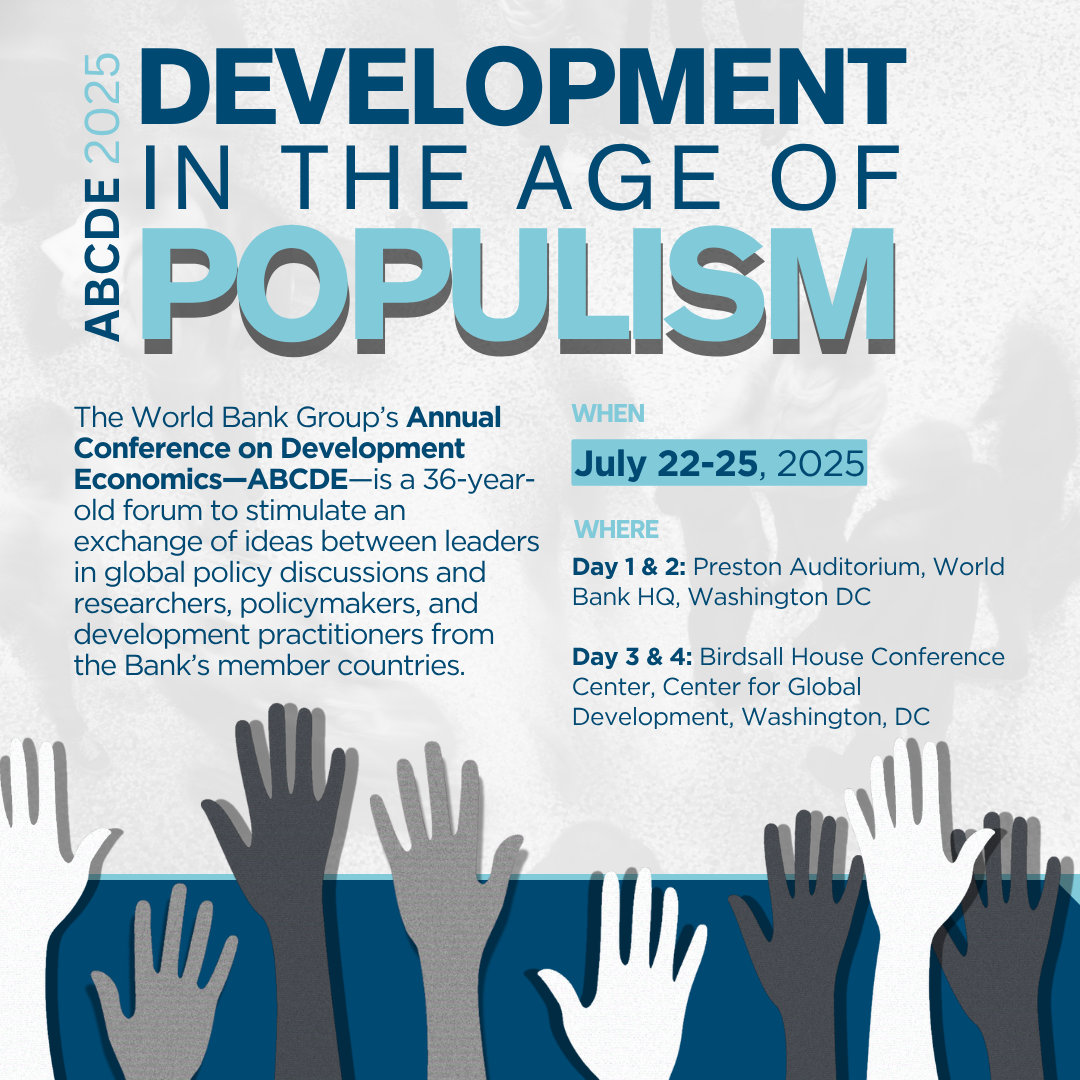
<img align="right" width="100%" src="https://DannyQuah.github.io/Storage/2025.07.22.Tue-ABCDE25-Development-Populism-Main-Card1.png" alt="World Bank ABCDE 2025:  Development in the Age of Populism" />
<figcaption>World Bank ABCDE 2025:  Development in the Age of Populism</figcaption>
</figure>

<hr />

<p>In East Asia we find it dissonant how so many observers around the world equate the process of economic development with just capacity building.  Here, our experience has been different: we see capacity building as necessary but not sufficient for growth.  This distinction is brought into ever sharper relief in today’s international environment of angry populism, frayed multilateralism, and recalibrated globalization.</p>

<p><strong>Development and its traditions</strong></p>

<p>Conventional scholarship and policymaking have concentrated on improving the human capital of people in the emerging economies.  The focus has been on improving health, raising skills and education, building infrastructure, shifting the workforce from low-productivity activities to high-productivity industry.  To that end, schools have been built, textbooks provided, teachers rewarded, basic medications trialled.  In village after village, township after township, improvements in individual circumstances in health, basic education, and personal finance have successfully moved billions of people from circumstances where they made poor choices to where they better control their own destiny.  No emerging economy that has succeeded has done so without improving the health, skills, and education of its people.</p>

<p>This kind of capacity building puts in place improvements that are obviously necessary for growth in any developing economy.  The question is, are they sufficient?</p>

<p><strong>Development is not just capacity-building.  It is also about the demand side</strong></p>

<p>In the history of development in East Asia—whether that part around Singapore or around China—we carried out capacity building too.  But we did more.  We operated in the knowledge that capacity-building was just one side of the equation, the supply side.  Explicitly or otherwise, we noted the importance of the other side, the demand side.  We knew our hinterland was too diminutive or too poor to provide sufficient demand for the increased supply that development policy was building.  So, in East Asia, we balanced the equation by always making sure we connected with large, rich markets elsewhere.  This provided demand.  When global demand was elastic and needed little further attention, we could focus on capacity building, and that was then indeed economic development.</p>

<p>The problem we had faced previously is now everywhere.  The large looming threat to well-being in the developing world today is that multilateralism and globalization are on the retreat, and with them the international environment that allows traditional capacity building to grow economies.  Global demand today is no longer elastic and needs a great deal of attention.  Without elastic demand, capacity building doesn’t create jobs.  It increases unemployment.  This drives populism which, in turn, raises xenophobia and protectionism, and through those fray multilateralism even further.  This is a vicious cycle of failure to develop.</p>

<p>Improving productive capacity helps emerging economies grow only if demand is elastic for what these economies produce.  Without elastic demand—because markets elsewhere are closing in on themselves—raising supply-side productivity doesn’t raise living standards: it creates frustration.  In these circumstances, capacity-building makes populations angry and worsens relations with yet other nations: both xenophobia and protectionism shrink a nation. Without elastic demand between nations, an economy’s improvement in skills, health, and education doesn’t create jobs:  It increases unemployment.</p>

<p>The rise of populism and the withdrawal of multilateralism call for small developing economies to do more than just stand by, simply continuing their old ways of only capacity-building.  But even if they might counter their domestic populism, how can small poor nation states exercise agency in an international system when the major powers are turning their backs on internationalism and multilateralism?</p>

<p><strong>Development needs to step up on its international responsibility</strong></p>

<p>Will development policy and research take demand-side lessons from East Asia, and pivot to engage with these new emerging challenges?  How can small developing states help build out again an international system to restore the best of multilateralism?</p>

<p>The challenge is profound.  Rising populism and xenophobia and the withdrawal of multilateralism give advanced nation-states many reasons to be narrowly self-seeking and to not collaborate with each other.  Developing economies, however, do not have that luxury.  If collaboration is difficult, development economies should look instead to inadvertently cooperate, i.e., to do the right thing even if it’s for the wrong reason.  After all, as Adam Smith pointed out, “It is not from the benevolence of the butcher, the brewer, or the baker that we expect our dinner, but from their regard to their own interest.”</p>

<p>When advanced nations retreat from internationalism, developing economies should build and strengthen networks of their own.  BRICS+ can be repurposed along streamlined domains, not just as a portmanteau opposition to the advanced West.  Networks can be purpose-built for trade according to multilateral rules, or for yet other forms of rules-based cooperation, in a plurilateral way.  ASEAN and the Global South might look to one another for coalitions of the willing.  At the same time, these networks should remain open to allow in yet other nations, provided only that those seeking entry agree to follow the rules.  Call this pathfinder multilateralism.</p>

<p>The developing world will need diplomats and trade officials as much as teachers and engineers, international engagement skills and mindsets as much as sleeping sickness tablets and mosquito nets.  Development needs to advance on both international and domestic dimensions simultaneously.  Development needs to be more than just health and education, and capacity-building has to encourage demand growth—both domestic and foreign—not just strengthen supply.</p>

<hr />

<p>Gill, I., Glennester, R., and Quah, D. 2025. “<a href="https://www.worldbank.org/en/events/2025/07/22/abcde-2025">Development in the age of populism</a>”, World Bank blog (Jun)</p>

<p>Quah, Danny. 2025. “<a href="https://www.imf.org/en/Publications/fandd/issues/2025/09/point-of-view-multilateralism-can-survive-the-loss-of-consensus-danny-quah">Multilateralism Can Survive the Loss of Consensus</a>”, <em>IMF Finance and Development</em> (Sep), pp. 14-15</p>

<!---
   Invisible section // 2025-09-13-Economic-Development-Capacity-Building.md
-->]]></content><author><name>Danny Quah</name><email>D.Quah@nus.edu.sg</email></author><summary type="html"><![CDATA[Economic Development Needs To Be More Than Just Capacity Building]]></summary></entry><entry><title type="html">Multilateralism Can Survive the Loss of Consensus</title><link href="https://www.dannyquah.com/2025/09/11/Multilateralism-without-Consensus/" rel="alternate" type="text/html" title="Multilateralism Can Survive the Loss of Consensus" /><published>2025-09-11T00:00:00+00:00</published><updated>2025-09-11T00:00:00+00:00</updated><id>https://www.dannyquah.com/2025/09/11/Multilateralism-without-Consensus</id><content type="html" xml:base="https://www.dannyquah.com/2025/09/11/Multilateralism-without-Consensus/"><![CDATA[<h3 id="multilateralism-can-survive-the-loss-of-consensus">Multilateralism Can Survive the Loss of Consensus</h3>

<p>by<br />
Danny Quah<br />
Sep 2025</p>

<p>Synopsis:  International cooperation can advance, even when the most powerful players are at odds.</p>

<p>WhatsApp-Broadcast: The Realists are right. The world is unlikely to see an outbreak of love and internationalist goodwill anytime soon. But while those qualities might induce global collaboration, their absence doesn’t mean anarchy and chaos:  They are sufficient but not necessary for an orderly world.  After all, it is not from the goodwill of Apple, Google, or Netflix that our lives have been enriched, but from their self-interest.  Multilateral cooperation can survive the loss of consensus.  But we have to work for it.</p>

<p>(This is a preprint version of:</p>

<p>Quah, Danny. 2025. “Multilateralism Can Survive the Loss of Consensus”, <em>IMF Finance and Development</em> (Sep), pp. 14-15<br />
https://www.imf.org/en/Publications/fandd/issues/2025/09/point-of-view-multilateralism-can-survive-the-loss-of-consensus-danny-quah</p>

<figure>
<img align="right" width="100%" src="https://DannyQuah.github.io/Storage/2025.09-Danny.Quah-Multilateralism-Consensus-IMFFD-card.jpg" alt="Quah, 2025.  IMF Finance and Development (Sep), pp. 14-15" />
<figcaption>Quah, 2025.  IMF Finance and Development (Sep), pp. 14-15</figcaption>
</figure>

<p>which is edited, cleaner, and nicely typeset.)</p>

<hr />

<p>Can adversarial nations work together for the common good? It’s natural to despair over prospects for international cooperation given the state of world order. Geopolitical competition is straining the multilateral system, which has helped maintain global stability since the Cold War. The most powerful nations cannot seem to agree on how to solve urgent global problems from the climate crisis to governing economic competition and international trade to regulating artificial intelligence.</p>

<p>Geopolitical competition doesn’t naturally advance international cooperation. The economic historian Charles Kindleberger showed how a lack of global leadership and international cooperation prolonged the Great Depression. Yet at other times geopolitical competition has, paradoxically, raised international cooperation. During the Cold War, for example, Presidents Dwight Eisenhower and John Kennedy advanced US leadership in open markets, free trade, and other global public goods to counter communism.</p>

<p>Multilateralism is splintering today—not because of geopolitical competition alone—but because it’s an expensive global public good. It benefits all humanity but distributes costs unevenly across nations.</p>

<p>Even in today’s polarized world, geopolitical rivals can still agree on common goals—the planet should be hospitable to humanity, the next pandemic should be controlled and confined through sensible public health safeguards, global economic policy should yield prosperity for all. Nations might disagree on how to achieve these goals—arguing that one approach or another unfairly benefits a rival—or they might accuse others of free riding by failing to contribute toward solving a common problem.</p>

<p>Carbon, for example, has been accumulating in the atmosphere for centuries. How should we divide the burden of tackling climate change between past and present emitters? Or how should we share responsibility for providing financial stability and restoring global growth? An advanced economy might expend considerable resources to ensure growth and stability while others fail to behave prudently.</p>

<p><strong>Middle powers</strong></p>

<p>If great powers refuse to support the international system, can others take their place? Global public goods are costly to provide. Small poor economies don’t have the resources to patrol the seas to keep shipping lanes safe for international commerce or to pump trillions into the world economy when markets fail. But middle powers—those with sufficient economic and financial firepower—may be candidates to take over the role of great powers. And middle powers that are not on the front lines of great rivalries and are committed to rules-based order are in fact playing an increasingly consequential role.</p>

<p>Without continuing US leadership, rules-based free trade agreements have already emerged. Consider the Comprehensive and Progressive Agreement for Trans-Pacific Partnership, the 12-member free trade pact that rolled out after the US failed to ratify its precursor, the Trans-Pacific Partnership. This new agreement even includes the United Kingdom, not a Pacific nation: Open economies appreciate arrangements built on a predictable rules-based system.</p>

<p>Middle powers can afford to provide global public goods more easily than can small states. But they are just as likely as great powers to be swayed by diminishing incentives and are just as unlikely to uphold multilateralism if they see no net benefit. Support for multilateralism must align with their self-interest. Their actions must, in other words, be incentive compatible.</p>

<p>If the international system is to endure, it must have more than just great- or middle-power leadership. Incentive compatibility must replace the idea that size matters and will add more to the resilience of the international system than explicit contractual collaboration agreements. All nations must contribute in a way that delivers visible gains for everyone. But how is this possible without goodwill or consensus between critical actors? I propose three pathways.</p>

<p><strong>Inadvertent cooperation</strong></p>

<p><em>First, policymakers should seek opportunities for inadvertent cooperation.</em> Cooperation emerges naturally when countries agree on a common solution to a problem and can lay out explicit articles of collaboration. Inadvertent cooperation, however, means that countries cooperate even when they disagree: It’s about doing the right thing even if for the wrong reason.</p>

<p>Inadvertent cooperation is most evident when there are positive spillover benefits. During the COVID pandemic, nations raced to find a vaccine. Faster vaccine development was made possible by a combination of mRNA technology and competition between companies in different countries. The process meant building on what others had discovered, but competition yielded vaccines that benefited everyone.</p>

<p>Consider the energy transition. If one country considers that a competitor is unfairly subsidizing production of electric vehicles, it could subsidize its own production rather than slapping tariffs on its adversary. Such subsidies are a sharp riposte to its adversary but also increase the supply of affordable clean-energy vehicles, which reduces carbon emissions. It’s a good outcome for all, even though everyone is acting for the wrong reasons.</p>

<p><strong>Prisoners’ dilemma</strong></p>

<p><em>Second, policymakers in smaller nations should nudge the international system out of gridlock</em>. When all countries seek their own self-interest, a prisoners’ dilemma can result: Every country acts in ways that are individually optimal but mutually destructive when taken collectively. No country can free itself from the dilemma: If it tries to do so unilaterally, others take advantage. When great powers get caught this way, a small nudge can persuade them to change course and pursue a collectively preferred outcome.</p>

<p>Advanced economies, for example, often hesitate to grant emerging economies greater access to their markets. Instead they put up barriers to trade, depriving developing economies of opportunities to become richer, in turn driving outward migration. This ratchets up political tensions on all sides. If developing economies can persuade advanced economies to act as a group, the impact of freer trade is minimized; imports are spread across the advanced economies, and rising incomes in developing economies reduce the incentive to emigrate. Nudging can help great and middle powers do what they want to do but cannot for fear of losing out to adversaries.</p>

<p><strong>Pathfinder multilateralism</strong></p>

<p><em>Third, policymakers should strive for pathfinder multilateralism</em>. When some nations turn their backs on multilateralism, subgroups of countries that favor it can still work together. The World Trade Organization’s Multi-Party Interim Appeal Arbitration Arrangement (MPIA) provides an independent appeals process to resolve trade disputes when the main appellate body can’t function because it is inquorate. MPIA membership has tripled to more than 50 nations since 2020. In pathfinder multilateralism coalitions act together to overcome problems. While the focus is different, these arrangements resemble what the IMF has called “<a href="https://www.imf.org/en/Publications/Staff-Discussion-Notes/Issues/2023/01/11/Geo-Economic-Fragmentation-and-the-Future-of-Multilateralism-527266">pragmatic multilateralism</a>.”</p>

<p>The Regional Comprehensive Economic Partnership is another example. The 15-nation free trade agreement is committed to rules-based order; it’s an inclusive arrangement and, beyond ASEAN, includes countries as politically diverse as Australia, China, Japan, New Zealand, and South Korea. Even as multilateralism is in retreat elsewhere, in the Asia Pacific it continues to be promoted by Southeast Asia.</p>

<p>International cooperation through multilateralism may seem impossible now, with consensus falling, particularly between geopolitical rivals. Yet inadvertent cooperation, overcoming the prisoners’ dilemma, and pathfinder multilateralism can restore the best of the international system.</p>

<!---
   Invisible section // 2025-09-11-Multilateralism-without-Consensus.md
-->]]></content><author><name>Danny Quah</name><email>D.Quah@nus.edu.sg</email></author><summary type="html"><![CDATA[Multilateralism Can Survive the Loss of Consensus]]></summary></entry><entry><title type="html">Pricing the China Shock: The Unintended Consequences of Sectoral Trade Protectionism</title><link href="https://www.dannyquah.com/2025/07/11/Pricing-China-Shock/" rel="alternate" type="text/html" title="Pricing the China Shock: The Unintended Consequences of Sectoral Trade Protectionism" /><published>2025-07-11T00:00:00+00:00</published><updated>2025-07-11T00:00:00+00:00</updated><id>https://www.dannyquah.com/2025/07/11/Pricing-China-Shock</id><content type="html" xml:base="https://www.dannyquah.com/2025/07/11/Pricing-China-Shock/"><![CDATA[<h3 id="pricing-the-china-shock-the-unintended-consequences-of-sectoral-trade-protectionism">Pricing the China Shock: The Unintended Consequences of Sectoral Trade Protectionism</h3>

<p>by<br />
Danny Quah<br />
Jul 2025</p>

<p>Synopsis: The China Shock can be measured in terms of import flows or, alternatively, as a price effect. Adopting the latter perspective, i.e., pricing the China Shock, helps explain, through a wage-price mechanism, why industrial policy attempting to protect specific sectors ends up, in reality, penalizing those same sectors.</p>

<hr />

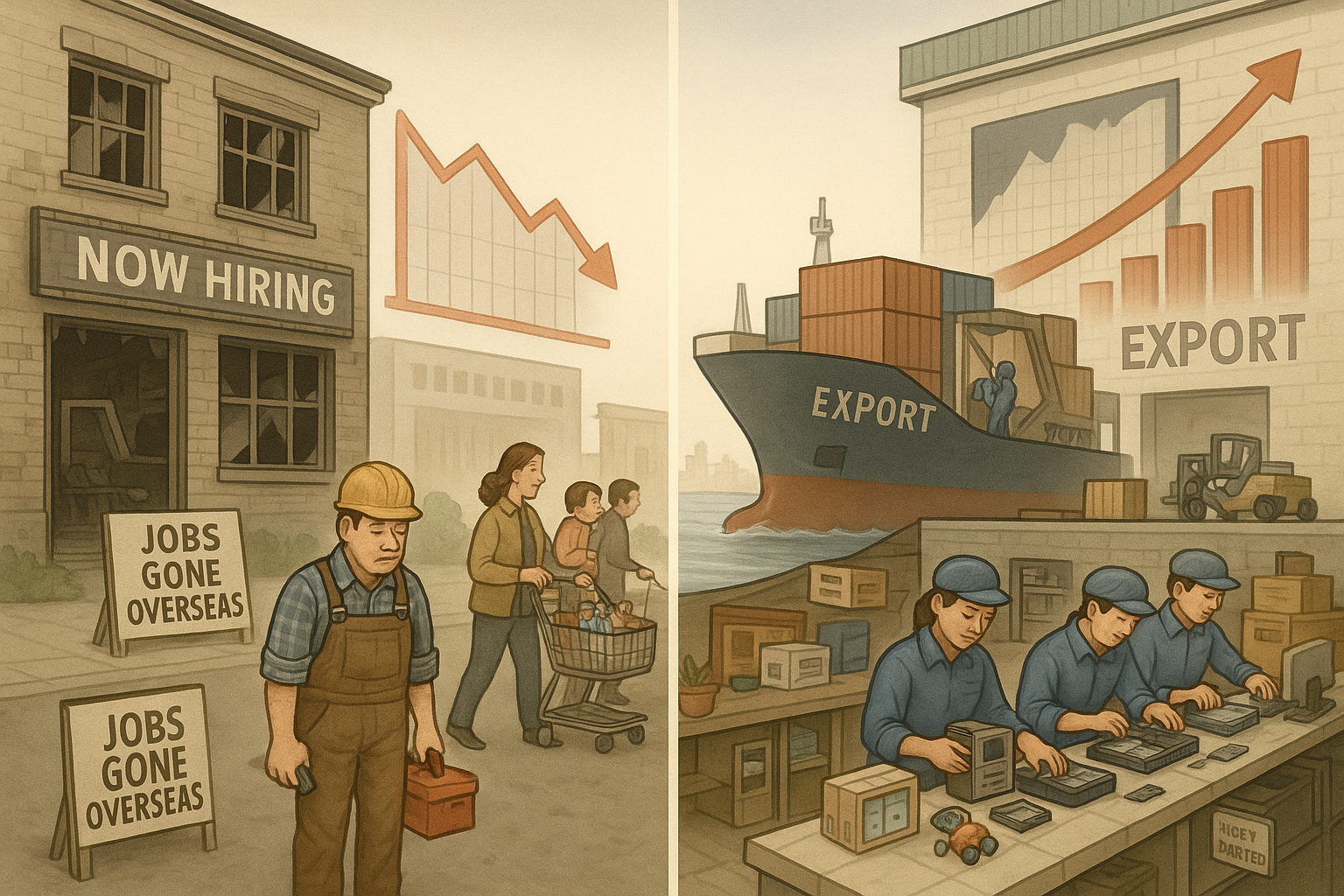
<p>Today, US narrative is that trade is unfair and unbalanced, and harms American businesses and workers.  Thus, trade needs to be adusted by protectionist policy.  Additionally, for reasons of national security, resilience, or geopolitical objectives, industrial policy might be called for as well.  The two, trade protectionism and industrial policy, can gainfully work together.</p>

<p>The typical objection to this is that protectionism creates inefficiency, even if industrial policy might well do the right thing.  I argue here that beyond just inefficiency, such policies have the unintended consequence of immiserising the very industry being protected.</p>

<figure>
<img align="right" width="100%" src="https://DannyQuah.github.io/Storage/ChatGPT-China-Shock-jobs-flow-2025.07.png" alt="ChatGPT - The China Shock.  Jobs flow" />
<figcaption>Chat GPT - The China Shock.  Jobs flow</figcaption>
</figure>

<p>Two mechanisms matter:</p>
<ol>
  <li>(A trade-price effect) Whether trade is unfair and unbalanced or otherwise, trade always changes relative prices.  Whatever happens to the magnitude of imports, that change in relative prices has real effects.  When prices shift, someone somewhere will feel disadvantaged.  Unless those people see their loss sufficiently compensated somehow, they will exercise what political leverage they can against trade.  This has nothing to do with trade being unfair or unbalanced, and is independent of whether the bilateral trade balance is in surplus or deficit;</li>
  <li>(A non-tradeable price effect)  If policy erects barriers so that a certain part of the economy is protected from trade, that creates a non-tradeables sector.  This might arise because of industrial policy, say, that seeks to reshape the landscape of industrial activity.  In this case, a version of the Balassa-Samuelson effect kicks in:  Improvements in the technology of the newly-created non-tradeables sector reduces price there and harms businesses.  This reduces the incentive to innovate.  The more advanced is technology in the non-tradeables sector, the worse is the downward impact there from ever more successful exchange in the traded goods sector.  But for trade in particular my point here is that as long as labour markets continue to operate, any price shock due to trade propagates to downward pressure on prices of non-tradeables as well, through wage effects in labour markets.</li>
</ol>

<p>The implication of the trade-price effect is that even when trade is fair and balanced, and comparative advantage theory applies to make for win-win outcomes, there can still be political opposition against trade.  The implication of the non-tradeable price effect is that protectionism directed at specific sectors—because of an industrial policy approach, say—does not, in actuality, protect those sectors.</p>

<p>The trade-price effect might seem, at first, unusual, but it is just a generalization of a different idea, now considered conventional. In economic analysis comparative advantage can coexist with trade increasing inequality.   A rise in inequality can engender escalation in populist activity and political opposition to trade.</p>

<p>Connecting this with the trade-price effect, observe that while there might be variety in the different possible mechanisms underlying political opposition to trade, one simple unifying idea connects them all.  This is that trade changes relative prices.  And, when relative prices change, someone somewhere in the economy is disadvantaged.</p>

<p>When prices happen to move against the poor, this is a rise in inequality.  Thus a special case of the trade-price effect is simply the trade-inequality relation.  But, depending on initial conditions and factor proportions, prices might move not agains the poor but can instead against the rich.  Even if that reduces inequality then, the rich who are disadvantaged by trade can marshal even greater political opposition to trade.  When prices move against large national champions in industry, nationalism will arise to oppose trade.  When prices move against smaller but emerging industries, opposition to trade can emerge from infant-industry proponents.  Depending on where national elites have invested, the change in relative price can either line the pockets of those elites or engender opposition from their political rivals.</p>

<figure>
<img align="right" width="100%" src="https://DannyQuah.github.io/Storage/2024.08-Danny.Quah-Correlated-Trade-Geopolitics-Fractured-Order-import-prices-US-figure.png" alt="Quah 2025 - US Import and Domestic Prices, Fig. 1" />
<figcaption>Fig. 1 in Danny Quah. 2025, "Correlated Trade and Geopolitics Driving a Fractured World Order", Ch. 5 in *The New Global Economic Order*</figcaption>
</figure>

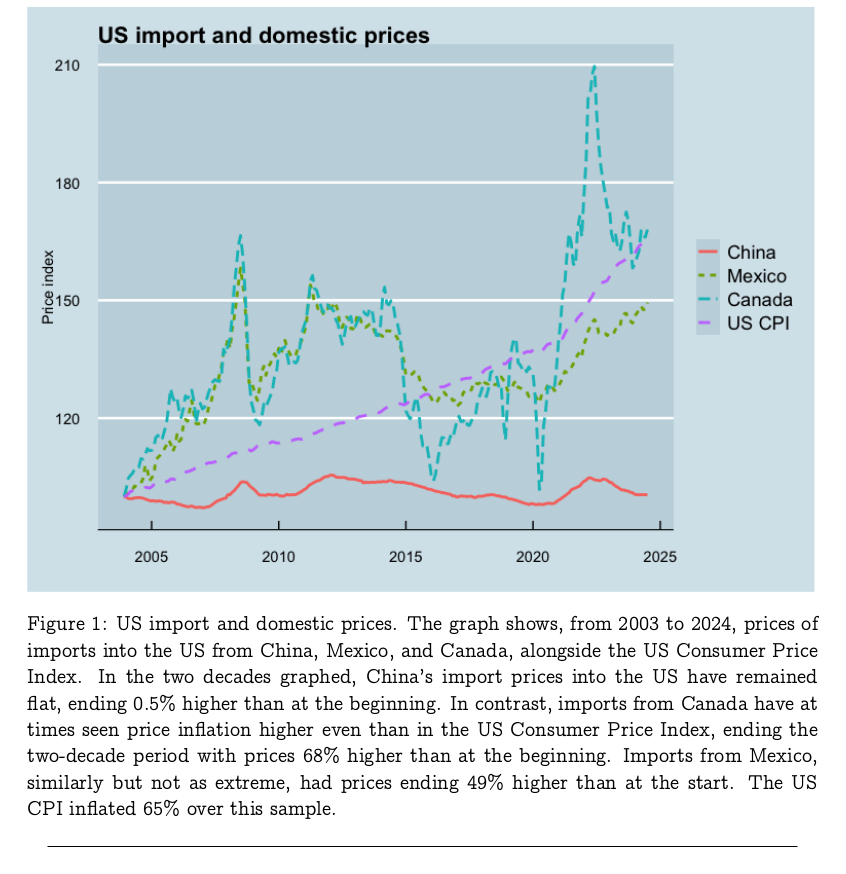
<p>The Figure shows perhaps the largest of such price disruptions over an extended period of time.  The data graphed are timeseries, over 2003-2024, of price indexes important for assessing US trade.  The three rising graphs are, respectively, the US Consumer Price Index and the price indexes for imports from Canada and Mexico.  Over the last quarter century, US consumer prices have risen 65%; Canadian import prices by 68%; Mexico import prices, 49%.  Thus, Canadian imports have kept pace with US consumer prices, while Mexican imports have become marginally cheaper.</p>

<p>It is the fourth line in the Figure that is most critical:  this is the price index for imports from China.  Its graph shows, in essence, zero change for the entire last quarter of a century.  Even as Chinese exports to the US have transitioned from primarily low-tech manufactures and plastic toys to high-quality frontier technologies, they have remained as cheap for the US consumer today as they were over two decades ago.</p>

<p>However, those same features in the graph show also the intense competition faced by US businesses and workers in those industries for which these exports substitute.  Why would US consumers buy goods whose prices have risen by 70% over others that are comparable or of even better quality?</p>

<p><strong>Protectionism Punishing Those Sectors Being Protected</strong></p>

<p>The significance of the non-tradeables price effect is that the impact of a severe price shock, such as in the Figure, is not confined to just the traded-goods sector.  Suppose that policymakers act to ringfence some sector of the economy, therefore creating a new non-tradeables sector.</p>

<p>The negative price shock in the trade goods sector, for a given level of technology, will put downward pressure on wages in traded goods.</p>

<p>But in an integrated labour market, that reduces wages in the newly-created non-tradeables sector as well.  This is the wage-price mechanism.  Unless technology in the non-tradeables sector compensates, the price of ringfenced-non-tradeables will fall.</p>

<p>(In symbols the argument uses the fact that in equilibrium $w = p \times \theta$, where $w$ is wage, $p$ is price, and $\theta$ representing technology—with one such equation for the traded goods sector and one for the nonetradeables sectors.  A functioning labour market equalizes wages.  Then for fixed $\theta$, one each in the traded and non-traded sectors, a reduction in $p_T$—the price in the traded goods sector—translates into a proportional reduction in $p_{NT}$, with constant of proportionality equal to $\theta_T / \theta_{NT}$.   The greater the separation between technology levels in trade and non-tradeable sectors, the larger the multiplier effect on prices in the non-tradeables sector. A more extended and mathematically visible argument appears as a version of the Balassa-Samuelson effect that I used in “Why Small Nations Unexpectedly Succeed”, 2024.)</p>

<p>Pricing the China Shock—rather than just looking the size and direction of imports—helps explain an unintended consequence of industrial and trade policy.  Raising protectionist barriers in specific sectors does not, in actuality, protect those sectors from the price shock that is trade.</p>

<p><strong>References</strong></p>

<p>Kennedy, Scott and Mazzocco, Ilaria. 2022. “The China Shock: Reevaluating the Debate,” Big Data China, Center for Strategic and International Studies, October 14, 2022, last modified 11 Apr, 2024  <a href="https://bigdatachina.csis.org/the-china-shock-reevaluating-the-debate/">https://bigdatachina.csis.org/the-china-shock-reevaluating-the-debate/</a></p>

<p>Quah, Danny.  2024.  “Why Small Nations Unexpectedly Succeed:  Trade, Technology, and the Washington Consensus”, LKYSPP Working Paper, Mar <a href="https://DannyQuah.github.io/working-papers/2024-02-small-nations-succeed/">https://DannyQuah.github.io/working-papers/2024-02-small-nations-succeed/</a></p>

<p>Quah, Danny. 2025. “Correlated Trade and Geopolitics Driving a Fractured World Order”, Ch. 5, pp. 54-66, in Ing, Lili Yan and Rodrik, Dani (eds.) <em>The New Global Economic Order</em>, New York: Routledge.  <a href="https://DannyQuah.github.io/publications/2025-04-Danny.Quah-Correlated-Trade-Geopolitics-Fractured-Order-NEO/">https://DannyQuah.github.io/publications/2025-04-Danny.Quah-Correlated-Trade-Geopolitics-Fractured-Order-NEO/</a></p>

<p>Quah, Danny. 2025.  “Response to Ricardo Hausmann by Danny Quah: The Trade-Technology Relation in Small and Poor Economies”, in Besley, Tim, Bucelli, Irene, and Velasco, Andres (eds.) <em>The London Consensus: Economic Principles for the 21st Century</em>, London: LSE Press, pp. 181-193  <a href="https://DannyQuah.github.io/publications/2025-03-Danny.Quah-Small-Poor-Trade-Technology-TLC">https://DannyQuah.github.io/publications/2025-03-Danny.Quah-Small-Poor-Trade-Technology-TLC</a></p>

<!---
   Invisible section // 2025-07-11-Pricing-China-Shock.md

-->]]></content><author><name>Danny Quah</name><email>D.Quah@nus.edu.sg</email></author><summary type="html"><![CDATA[Pricing the China Shock: The Unintended Consequences of Sectoral Trade Protectionism]]></summary></entry><entry><title type="html">Dealing with a Two-Shock International System</title><link href="https://www.dannyquah.com/2025/05/01/Dealing-with-a-Two-Shock-International-System/" rel="alternate" type="text/html" title="Dealing with a Two-Shock International System" /><published>2025-05-01T00:00:00+00:00</published><updated>2025-05-01T00:00:00+00:00</updated><id>https://www.dannyquah.com/2025/05/01/Dealing-with-a-Two-Shock-International-System</id><content type="html" xml:base="https://www.dannyquah.com/2025/05/01/Dealing-with-a-Two-Shock-International-System/"><![CDATA[<h3 id="dealing-with-a-two-shock-international-system">Dealing with a Two-Shock International System</h3>

<p>by<br />
Danny Quah<br />
May 2025</p>

<p>If we’ve grown used to the China Shock—“a tsunami of Chinese manufactures that compete ferociously with our own”—let’s also call the Trump Administration’s continuing turmoil what it is: the America Shock.</p>

<p>The China Shock is a supply shock.  This throws up a tsunami of high-quality, low-priced products against which manufacturers in the rest of the world see considerable competitive challenge.</p>

<p>The America Shock is a demand shock.  This puts up trade barriers so that companies the world over, not just Chinese ones, face ever greater obstacles selling what they produce.</p>

<p>For the 80% of humanity who lives in neither China nor the US, it is not for us, just as when we confront all other shocks, to approve or disapprove.  It is to ask, What is the smartest thing to do in a two-shock world?</p>

<p><img src="http://DannyQuah.github.io/Storage/2025.04.10.Thu-Trumps-Trade-Wars-GiA-LKYSPP.png" alt="GiA LKYSPP. 2025. Trump's Tariffs, Global Strategy" /></p>

<p>A supply shock that brings to bear added competitive pressure is not something anyone relishes in the short term.  Significant parts of America’s narrative on the China Shock is one of China’s “stealing our jobs, hollowing out our industries, turning into ghost towns what were once thriving American middle-class communities.” It is not just America that sees this threat.  America’s reaction has been to push back against the China Shock.   For the rest of us, that won’t be geostrategically optimal.</p>

<p>Think about what America tells the rest of the world when we face those same competitive pressures, not least from America’s companies.  Almost all economic thinking argues that economies having to deal with added competition work harder, innovate more, figure out ways to improve their way of doing things, raise productivity, and increase efficiency.  This is what business schools teach their students to go out and practice. Choosing not to keep up means Schumpeterian creative destruction.  A supply shock endures.  In the long run, a supply shock is good for everyone when they have dealt constructively with it.</p>

<p>This isn’t painless, but it’s how the world has worked for millennia.  It is not for us to approve or disapprove.  Most of all, this is not a question of fairness. The question is, What is the smartest thing to do in response?  It does not matter how that supply curve shifted, how it was that added competitive pressure came about.  No one who asks if the playing field is truly level ever succeeds in re-tilting that playing field.  The way to deal with competition is not to complain but to innovate.</p>

<p>America’s renewed protectionism is not just against China but against everyone who the Trump administration sees having trade relations with the US and is economically successful and so somehow must have cheated.  (Yes, we’re looking at you, Heard Island and McDonald Islands).  This is a demand shock.  It is not only China but all the rest of the world that no longer sees, at the margin, strong, elastic demand for what it produces.</p>

<p>Most demand shocks are transitory.  This time, however, America could well retreat longer-term to its historical, romanticized vision of being satisfied unto itself, surrounded only by friends and fish.  America’s retreat from the globalization principles of “economic efficiency, comparative advantage, and political convergence” has been a longer-term trend that extends well before Trump 1.0 and continued uninterrupted between Trump 1.0 and 2.0.</p>

<p>The optimal response to a demand shock depends on what we estimate to be its elasticity and duration.  Should the rest of the world accommodate and haggle?  Is there a deal to be made still? Or should we write off our losses and look elsewhere for new markets?</p>

<p>Regardless whether America’s trade actions or its security recalibration are ultimately rolled back, “<a href="https://edition.cnn.com/2025/04/02/economy/key-takeaways-from-trumps-liberation-day-tariffs/index.html">Liberation Day 2025</a>” shows that, whoever you are, your nation can have the US act against you.  It doesn’t matter if you have zero tariffs on US imports, allow the US to run a trade surplus against you, are a democracy, are not the People’s Republic of China, have outstanding security and economic treaties with the US (perhaps even signed by President Trump), or be in a centuries-old special relationship with America.  The Trump administration might well say it is looking only for good deals, but that word “deal” is quickly turning to ashes in our mouths.  A deal means an agreement whose terms are kept to over an agreed-upon length of time.</p>

<p>There is no deal in this demand shock.  What we see instead is the deliberate fraying of the world’s multilateral rules-based system.  The brutally large fact of the matter, beyond the madness of day-to-day announcements emerging from the Trump administration, is that the US is actively undermining the rules-based multilateral system that it built.  This is after two decades of America’s warning the rest of us that China was gaining the strength to soon become a dangerous revisionist disruptor of world order.</p>

<p>We were all looking at supply, when we should have been watching demand.</p>

<p>Yes, of course, there are strategic security and economic reasons to America’s actions.  Those reasons do not overturn the harm that these actions are having on the international economic system, nor to the standing of the US in world order.  It is sometimes thought that that last is controlled by how powerful the US is or how strong a military the US has.  It isn’t.  For the US (or for any other Great Power) it is the rest of the world that has ownership on America’s standing and respect.</p>

<p>Obviously, we shouldn’t lash out at America in retaliation.  But neither should we acquiesce and appease.  Not responding with pushback does not mean quietly giving in to bullying.  There is clear blue water between these two extremes.  When we encounter a bully, the two gravest errors we can make is to give in and then encourage the bully to ask for yet more, and to not resolutely stand in unison but instead give in to the temptation to defect.</p>

<p>Even as we continue to want the US to be in the international economic system along with all the rest of us, we need to look also to building one without it.  There is no point saying we shouldn’t because it won’t be as good without America.  Of course we want the US (and any other Great Power) alongside us as we deal with the grand challenges of our time.  But the US has already withdrawn from the Paris Agreement, the World Health Organization, and in effect the World Trade Organization.</p>

<p>You can’t depend on what you cannot have.  You can’t just sit on the inventory of goods you’ve produced, refusing to do something else with it, but hoping against hope that demand will return.</p>

<p>The world no longer has a truly global multilateral system because the original architect has withdrawn.  That demand shock and marketplace destruction will almost surely continue.  But the world can at least look to new variants in pathfinder multilateralism, keeping the best of the earlier system and building out new structures that work, if only for specific coalitions of states.</p>

<p><a href="https://www.youtube.com/watch?v=JWTyMCdK1zo"><img src="http://DannyQuah.github.io/Storage/2025.04-CNA-When-Titans-Clash-SEAsia-manufacturers.jpg" alt="Channel News Asia. 2025.  Southeast Asia's Manufacturers (Apr)" /></a></p>

<!---
   Invisible section // 2025-05-01-Dealing-with-a-Two-Shock-International-System.md
-->]]></content><author><name>Danny Quah</name><email>D.Quah@nus.edu.sg</email></author><summary type="html"><![CDATA[Dealing with a Two-Shock International System]]></summary></entry><entry><title type="html">Resilience through cooperation: With or without multilateral consensus</title><link href="https://www.dannyquah.com/2025/03/31/Resilience-Cooperation-Multilateralism/" rel="alternate" type="text/html" title="Resilience through cooperation: With or without multilateral consensus" /><published>2025-03-31T00:00:00+00:00</published><updated>2025-03-31T00:00:00+00:00</updated><id>https://www.dannyquah.com/2025/03/31/Resilience-Cooperation-Multilateralism</id><content type="html" xml:base="https://www.dannyquah.com/2025/03/31/Resilience-Cooperation-Multilateralism/"><![CDATA[<h3 id="resilience-through-cooperation--with-or-without-multilateral-consensus">Resilience through cooperation:  With or without multilateral consensus</h3>

<p>by<br />
Danny Quah<br />
Mar 2025</p>

<p>How can the global economy and its institutions build international resilience through global cooperation?  This article looks at both promise and challenge in multilateralism.  Given the parlous state of the international system, modalities other than pure multilateralism will be needed.  The article describes three possible ways ahead.</p>

<p>(The key ideas here were presented at IMF’s High-Level Forum “Asia and the IMF:  Resilience through Cooperation” in Tokyo, Wed 05 Mar 2025.  I thank Chatib Basri, Kenneth Kang, Jun Ma, Takehiko Nakao, Mari Pangestu, Ceyla Pazarbasioglu, Krishnan Srinivasan, and other participants at the event for their comments and suggestions.)</p>

<hr />

<p><strong>Resilience through cooperation is the right goal.  Multilateralism is a good platform to try and achieve that goal, but need not itself be the final objective</strong></p>

<p>At IMF and elsewhere the world is on a hunt for resilience.  Nearly all observers agree that yet more global disorder is imminent—pandemics, global climate crisis, AI and other disruptive technology, trade wars, geopolitical conflict.  How do we build resilience into the global economy so that our world seeks not only to be razor-sharp efficient (and then fragile) but instead to show both high productivity and the ability to recover from global shocks?</p>

<p>Cooperation is, of course, a good, sensible way to achieve the goal of resilience.  By definition, cooperation accords everyone appropriate space, voice, and responsibility in just the right degree, in order to achieve what objectives they set out for themselves in the best way possible.  But cooperation, while a fine aspiration, is not something that humanity always considers natural.  For instance, in some parts of the world and at certain times, global cooperation comes with a charge of surrendering national sovereignty, and so is politically unacceptable.  Or, cooperation might not align with a nation’s individual objectives—that nation would have to give up some well-being in order for the group to achieve a higher goal—and so is politically infeasible, or at least awkward.  Put differently, cooperation need not be always incentive-compatible.</p>

<p>Instead, therefore, <em>multilateralism</em> is a leading platform by which the world has sought to achieve the outcome of cooperation.  At first, this might not seem obvious, not least as multilateralism in different disciplines bears different meanings.  In economics, for instance, there is a fundamental theorem of welfare economics, where individual agents behaving according to simple rules—not collectively but just by themselves—nonetheless achieve social outcomes that are both optimal and individually incentive-compatible (i.e., are Pareto-preferred).  That, however, is a proposition about markets and price-taking behaviour.  Unfortunately, there is no counterpart theorem in economics, politics, or elsewhere for multilateralism achieving global cooperation.</p>

<p>But even without a general theorem, the possibility for multilateralism achieving optimal outcomes becomes more compelling if by multilateralism we mean at least the following three features: (1) a level playing field where all nations, large and small, participate with equal rights and obligations, including rules for free markets and open trade; (2) effective international organizations that maintain rules for that level playing field; and (3) outcomes determined through the system’s rules-based order, not by the doctrine of “might makes right”.  Items (1)-(3) would, I suspect, feature in most conceptions of the international rules-based order of the last seven decades.</p>

<p>(In this description, I diverge from economic writings where multilateralism is taken as represented by the international monetary system and a global financial safety net.  See, e.g., <a href="https://www.imf.org/en/Publications/Staff-Discussion-Notes/Issues/2023/01/11/Geo-Economic-Fragmentation-and-the-Future-of-Multilateralism-527266">Aiyar et al 2023</a>.  In the reasoning here, the monetary system and financial safety nets are potential outcomes of multilateralism, but they do not define it.)</p>

<p>Even if multilateralism as imagined above need not achieve cooperation exactly, most observers likely think it has some shot at coming close.  The challenge today, however, is not a question of how close multilateralism gets to delivering full cooperation.  Instead, the challenge is the opposite.  Multilateralism is fraying, and so the pathway from disorder to multilateralism to global cooperation grows ever less feasible.  Multilateralism is a global public good, its maintenance is expensive, and the cost of that support is unevenly distributed.  As the global economy continues to change, so too the balance between costs and benefits evolves differently for different nations.</p>

<p>Eight decades ago the US found great advantage to supporting a multilateral international economic system.  The Cold War against the Soviet Union had America’s adversary opposing free markets and open trade.  On this margin the US gained geopolitically from taking the contrary position, thus adding to the direct economic benefit that the US already drew from the multilateral international economic system.  The US had no close competitor in that system thus a great fraction of the system’s gains accrued significantly to the US itself.  For the US, both geopolitics and economics aligned in multilateralism.</p>

<p>But that margin of costs and benefits shifted.  First, the Cold War ended.  Today, not only do America’s greatest geopolitical adversaries no longer oppose free markets and open trade, they have instead benefited from multilateralism.  Second, and related, the global economy grew multipolar.  When, in the past, the world was obviously unipolar, America gained visibly every time the global economy grew due to multilateralism.  In this calculation, when the cost-benefit ratio rises, it becomes rational for the US and other similarly-positioned powers to pull back from providing multilateralism the support they had previously done.</p>

<p>Multilateralism is, therefore, significantly frayed.</p>

<p>But if the ultimate objective is resilience through cooperation, multilateralism is just one possible pathway to that goal.  It is not essential.  Yet other pathways might be possible.  To surface what those others might be, it is important to clarify possible misconceptions of risks in the international system.</p>

<p><strong>Risks and Misconceptions</strong></p>

<p>A first misconception: “Geopolitical rivalry is the cause of fraying in the multilateral system.”  While geopolitical competition doesn’t help, it is also not the principal cause of multilateralism weakening.  Instead, multilateralism is fraying because it is an expensive global public good, whose aggregate benefits are considerable but whose costs are unevenly distributed.</p>

<p>Additionally, free-riding in public goods provision of course leads to cooperation breaking down even when all participants agree on objectives.  Thus, preferences being aligned does not guarantee cooperation.  With free-riding there is, in fact, failure to cooperate even with consensus:  Geopolitical rivalry in that case is irrelevant to the breakdown of the multilateral system.</p>

<p>A second misconception follows from the first: “The breakdown of multilateralism comes with a global decoupling into separate camps or spheres of influence, each led by one of the Great Power adversaries locked in geopolitical rivalry.”  In this view, partitioning of the global economy then leads to economic inefficiencies.  IMF estimates that perhaps 7-12% of world GDP might be lost due to such global fragmentation.  This is a Cold War kind of scenario, analogizing from the decades-long confrontation between the US and the Soviet Union after the Second World War.  The Cold War also featured Kennedy-esque narratives of the “long twilight struggle” between democracy and freedom, on the one hand, against totalitarianism and tyranny on the other.  That was a time when the Great Powers carried deep, irreconcilable conflicts with each other, when everyday Americans thought the other side was out to destroy the American way of life and their entire system of government.</p>

<p>Today, the motivation for decoupling is not primarily ideological difference but instead economic competition.  Today, that motivation is the China Shock.  That disturbance—that China is “stealing American jobs, hollowing out American industry, turning into ghost towns where were once thriving American middle-class communities”—would engender the same response from Americans whether it arose from Chinese businesses’ cheating, from Chinese state intervention, or from simply China’s particularly devastating economic efficiency. The China Shock narrative is one that resonates for many observers, independent of its actual empirical validity or the fundamental cause of the Shock.</p>

<p>Moreover, the China Shock is not inconsistent with theories of Ricardian comparative advantage.  Its narrative is a statement about the distributional lived experience of different factors of production.  Comparative advantage, on the other hand, is a statement about aggregate effects on well-being.  The two are logically distinct but mutually compatible.</p>

<p>How Americans respond to the China Shock narrative makes for a crucial difference between circumstances today and in the 1950s-1970s.  At no time in the Cold War, were Soviets ever accused of taking American jobs or dismantling American industry.  The Soviet economy was an isolationist (and ultimately failing) machine; in no way could it have been viewed as sustainably engaged in competition with the US.  Great Power competition today is profoundly different from that during the Cold War.  Geopolitics is no longer just bad economics (e.g., Quah, <a href="https://dannyquah.github.io/2024/04/06/World-Order-Multipolarity-Multilateralism/">2024</a>).</p>

<p>This does not make the matter less serious.  The economics of the China Shock happens to align with international relations arguments in scholarly writings such as John Mearsheimer’s.  These latter suggest that the US will not tolerate the rise of a hostile hegemonic power—of whatever political complexion—in the Asia-Pacific region.  This is because such an ascent will end up restricting America’s prospects and freedom of actions.  In this reasoning, it is not central whether the rising power is a democracy.  Indeed, that the US seeks to contain China, in this view, does not draw on any wish to uphold an ideological position against an opposing model, as is suggested of the Cold War.  The adversary could just as easily be Japan or India, or any other sufficiently great power that is rising.  Middle Powers are not excluded.</p>

<p>Recognising economic reasons—not just geopolitics—to be among the ultimate causes for global fragmentation means that any enduring solution also needs to contain elements of economic resolution.  But, further, that acknowledgement also means that the right analysis cannot rely on a model of global fragmentation based on interpolated political alignment.  Global fragmentation will not be emerging on the basis of ideology; fractures will not be aligning with UN voting patterns.</p>

<p>Finally, a third misconception:  “Whatever happens to multilateralism, global fragmentation will be too costly, and hence policymakers will back away from decoupling.”  This is a fallacy of composition.  However high the aggregate cost of global fragmentation, that cost is not what is perceived at the individual level.  For many, the lived experience of global integration is more in sympathy with the narrative of the China Shock than with win-win welfare gains from comparative advantage.</p>

<p>To understand this, remember that if trade does anything, it changes relative prices.  When relative prices change, there will always be someone in the domestic economy who sees that change as prices falling on what they sell.  Regardless of the eloquence with which economists and policymakers laud open trade producing an efficient allocation of resources, such reasoning gains no traction with those workers and firms who see relative price move against them.  For such agents—who have every incentive to be vocal and pivotal in the political system, democratic or otherwise—global fragmentation is a gain, not a cost.  This is the case even if in the aggregate, net loss is by far the dominant feature of fragmentation. That those agents’ losses could, in principle, be more than compensated is irrelevant, as no one ever actually steps forward to make good on that compensation to them.  Global fragmentation, therefore, will not be held in check by the argument that its aggregate cost is high: politically pivotal workers and businesses see gains and losses that don’t align with what happens in the aggregate.</p>

<p>Along similar lines, the COVID pandemic raised the question of how far the world economy might need to retreat from its efficient allocation of global production and supply chains in order to achieve resilience.  If global production networks and supply chains were strained to razor-thin efficiency, then a retreat to <em>some</em> global fragmentation might be appropriate as a tradeoff, at the margin, for improved global resilience.</p>

<p>The global pandemic thus produced a shift in global preferences.  But so too do other changes: concern over national security could rise, perhaps even endogenously through the so-called security dilemma, where one nation increases its aggressiveness in response to other nations’ doing so, and in a vicious cycle these actions accumulate, each building on the other.</p>

<p>With such shifts in global preferences, the world should indeed, rationally, slide along the tradeoff frontier between erstwhile economic efficiency and other considerations such as resilience and security.  How much quantitatively it should do so, however, is not addressed by simply saying that the cost of global fragmentation is lowered world economic output.</p>

<p><strong>But if multilateralism is failing, then what?</strong></p>

<p>It is natural to hypothesize that if the Great Powers—for whatever combined reasons of China Shock, cost-benefit calculation, and geopolitical rivalry—are now unwilling to support multilateralism in the international system, then Middle Powers can step up and lead on doing so.</p>

<p>This belief draws from the fact that providing global public goods is costly.  In this view, only large and powerful nations can undertake that provision.  So, if not the Great Powers, then look to a combination of lesser powers.</p>

<p>But global public goods provision has two relevant dimensions to it:  One, affordability; the other, incentive.  Sure, Middle Powers find provision more affordable than would small states, and thus Middle Powers are more willing to bear the cost.  However, if it is diminishing incentive (the increasingly unfavorable cost-benefit ratio) that is degrading Great Power support for the multilateral system, that diminishing incentive operates at least as powerfully on Middle Powers as it does on Great Powers.  Middle Powers will be just as bad as Great Powers in upholding multilateralism, when push comes to shove.</p>

<p>Any enduring solution to the challenge of resilience in the international system needs to have more than just Great or Middle-Power leadership.  Small states need to be an integral part of the solution.  Or, more precisely, any enduring solution will need to focus on incentive compatibility.  It will need to discard the idea that size matters, but instead focus on all nations participating appropriately and everyone gaining in ways that align with their motivations.</p>

<p>Three distinct pathways suggest themselves.  <strong>First, seek inadvertent cooperation</strong>.  Cooperation is, of course, a natural corollary when states are in agreement and can set down explicit articles of collaboration.  Inadvertent cooperation, conversely, is when cooperation emerges even when states disagree.  Inadvertent cooperation, therefore, is about doing the right thing even if for the wrong reason.  While this might at first sound impossible, it is not that different from Adam Smith’s description of how “it is not from the benevolence of the butcher, the brewer, or the baker that we expect our dinner, but from their regard to their own interest.”  If your nation feels another is unfairly and illegally subsidizing the production of new energy vehicles, then subsidize your own as well, instead of sanctioning or placing tariffs on your adversary.  Subsidizing your own national industry gets back at the other nation, but in the process both nations end up providing the Global South and yourselves a greater supply of clean energy devices that will help address the global climate crisis.  This achieves a good outcome even if everyone is acting for the wrong reason.</p>

<p>Second, look to <strong>nudge the system out of gridlock</strong>.  When every nation seeks to advance their self-interest, Prisoners Dilemma situations arise where every nation undertakes actions that are self-optimal but collectively destructive.  When it is Great or Middle Powers caught in that gridlock, it takes only a small nudge to convince them to undertake a different action, and move to an otherwise unstable, not individually rational, but collectively preferred outcome.  Small states can provide that nudge.  Nudging can help Great and Middle Powers do what they would prefer to do, but cannot, for fear of retaliation by their adversaries.</p>

<p>Third, <strong>build subsystems of pathfinder multilateralism</strong>.  When the international community of nations sees defection from multilateralism, smaller subgroups within whom multilateralism remains incentive-compatible can still form and work together.  The WTO’s <a href="https://wtoplurilaterals.info/plural_initiative/the-mpia/">Multi-Party Interim Appeal Arbitration Agreement</a> is one such example, providing an independent appeals process to resolve WTO disputes while the WTO Appellate Body remains inquorate.  Such subgroups should remain open to new members who, over time, might join because they again see gain in participating.  Through example, rather than nudging, gridlock might still be evaded. Call this <em>pathfinder multilateralism</em>, characterized by voluntary membership and choice of problem domains.  While the focus of action is different, such a system bears some resemblance to what IMF calls “pragmatic multilateralism”, e.g., <a href="https://www.imf.org/en/Publications/Staff-Discussion-Notes/Issues/2023/01/11/Geo-Economic-Fragmentation-and-the-Future-of-Multilateralism-527266">Aiyar et al 2023</a> and <a href="https://www.imf.org/en/News/Articles/2024/03/04/sp030424-bretton-woods-80-years-ceyla-pazarbasioglu">Pazarbasioglu 2024</a>.</p>

<p><strong>Conclusion</strong></p>

<p>International cooperation is a natural way to try and achieve global resilience.  If the multilateral system of the last seven decades is fraying for geopolitical reasons, then through economic institutions, working against geopolitics, we might work to restore that system for the purpose of again inducing international cooperation.</p>

<p>In this article, I have provided three lines of argument on this challenge.  First, what were the hopes for multilateralism?  It is unclear why multilateralism is the right vehicle to achieve global cooperation.  But, second, multilateralism itself is fraying, not just for exogenous geopolitical reasons but from an endogenous alignment of economics and geopolitics.  Third, I have provided three suggestions for what the international community might do in the midst of this global fracturing:  seeking inadvertent cooperation; small state nudging Great and Middle Powers away from gridlock; building pathfinder multilateralism.</p>

<!---
   Invisible section // 2025-03-31-Resilience-Cooperation-Multilateralism.md
-->]]></content><author><name>Danny Quah</name><email>D.Quah@nus.edu.sg</email></author><summary type="html"><![CDATA[Resilience through cooperation: With or without multilateral consensus]]></summary></entry><entry><title type="html">Boao Forum: The Tragedy of Multilateralism for the Global South</title><link href="https://www.dannyquah.com/2025/03/30/Boao-Forum-Tragedy-Multilateralism-Global-South-Modernization/" rel="alternate" type="text/html" title="Boao Forum: The Tragedy of Multilateralism for the Global South" /><published>2025-03-30T00:00:00+00:00</published><updated>2025-03-30T00:00:00+00:00</updated><id>https://www.dannyquah.com/2025/03/30/Boao-Forum-Tragedy-Multilateralism-Global-South-Modernization</id><content type="html" xml:base="https://www.dannyquah.com/2025/03/30/Boao-Forum-Tragedy-Multilateralism-Global-South-Modernization/"><![CDATA[<h3 id="boao-forum--the-tragedy-of-multilateralism-for-the-global-south">Boao Forum:  The Tragedy of Multilateralism for the Global South</h3>

<p>by<br />
Danny Quah<br />
Mar 2025</p>

<p>At Boao Forum 2025, I spoke on a panel on Modernization of the Global South.</p>

<p>I made three points on how, as small economies (whether in population or in spending power or both), members of the Global South now see the pathway to modernization being pulled out from under them.</p>

<p>ONE // When you are a small economy, you reckon you develop by focusing on improving the health of your people, giving your people skills, housing your people, improving your nation’s infrastructure.  This is the “tablets, teachers, textbooks, and trains” route to modernization.  It is difficult to see how any economy could consider itself developed if it hadn’t done these things.  All these policies raise your production capacity.  They expand your supply side.  It’s how economies—ranging in size and circumstances all the way from Singapore through China—have developed successfully.</p>

<p>Such supply-side strategy, however, can only be a necessary, not sufficient factor for economic development and modernization.  But for the last seventy years it was enough because the other side—the demand side—always took what you supplied. Global demand was elastic.  An increase in the supply side without matching demand does not create jobs; it just causes unemployment.  But with the coming together of demand and supply, you also realized you gain more than proportionally through strength in groups, the larger the better.</p>

<p>TWO // No more.  Global demand was elastic because of two things:  globalization and multilateralism.  That rules-based international system provided order and a level playing field so every nation had equal opportunity to improve itself.  Multilateralism yielded benefits all around.  But multilateralism was also expensive to maintain, with costs unevenly distributed.  Now its original sponsors—the US and other rich, advanced, Transatlantic nations—no longer see gain for themselves to maintaining the international rules-based order.  This has nothing to do with global hegemons being unaware that their benevolent leadership was of great value to the world: it’s just that that form of leadership doesn’t benefit them enough anymore.  This is not right or wrong, or good or bad, or for us to approve or disapprove.  Erstwhile hegemons changing their behaviour and pulling back is the smart thing for them to do when costs outweigh benefits.  (In the talk I gave examples.)</p>

<p>Rich-country offshoring increased demand for production capacity, and thus created jobs in the recipient emerging economy.  Conversely, rich-country onshoring reduces labor demand in recipient emerging economies and so, at the margin, will destroy jobs and raise unemployment there.</p>

<p>THREE // This is the tragedy of multilateralism:  All international organizations eventually break down if what is expected to hold them together is goodwill, mutual exhortation, or a sense of duty.  Conversely, international organizations endure if every member finds it to their benefit to continue to collaborate, i.e., if the organization is incentive-compatible.  This is also why the Global South should not look to the Middle Powers to lead:  Middle Powers will be no better than the Great Powers at this.  Still-hopeful members, therefore, such as Global South economies, need to find combined strength elsewhere.  I suggest looking to inadvertent cooperation, i.e., cooperation without collaboration, or more straightforwardly having those you engage with do the right thing even if it’s for the wrong reason. (In the talk I gave examples.)</p>

<p><img src="https://DannyQuah.github.io/Storage/2025.03.26.1045.Wed-Global-South-Moving-towards-Modernization-DongYu-post.jpg" alt="Boao Forum Tragedy Global South Modernization" /></p>

<!---
   Invisible section // 2025-03-30-Boao-Forum-Tragedy-Multilateralism-Global-South-Modernization.md
-->]]></content><author><name>Danny Quah</name><email>D.Quah@nus.edu.sg</email></author><summary type="html"><![CDATA[Boao Forum: The Tragedy of Multilateralism for the Global South]]></summary></entry></feed>